
Elbow (Olecranon) Fractures
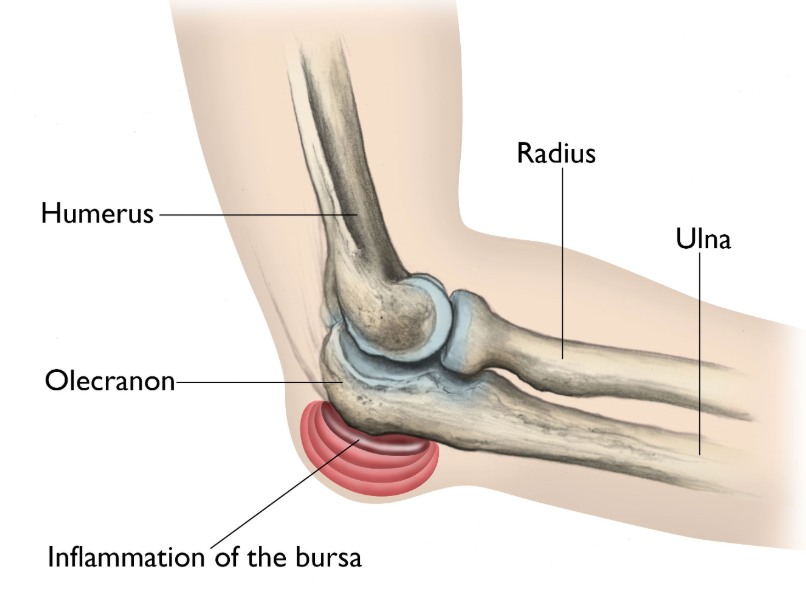
An olecranon (oh-LEK-rah-nun) fracture is a break in the bony "tip" of the elbow. This pointy segment of bone is part of the ulna, one of the three bones that come together to form the elbow joint.
The olecranon is positioned directly under the skin of the elbow, without much protection from muscles or other soft tissues. It can break easily if you experience a direct blow to the elbow or fall on an outstretched arm. A fracture can be very painful and make elbow motion difficult or impossible.
Treatment for an olecranon fracture depends upon the severity of the injury. Some simple fractures can be treated by wearing a splint until the bone heals. In most olecranon fractures, however, the pieces of bone move out of place when the injury occurs. For these fractures, surgery is required to restore both the normal anatomy of the elbow and motion in the joint.
Anatomy of Elbow
Your elbow is a joint made up of three bones:
- The humerus (upper arm bone)
- The radius (forearm bone on the thumb side)
- The ulna (forearm bone on the pinky side)
The elbow joint bends and straightens like a hinge. It is also important for rotation of the forearm; that is, the ability to turn your hand palm up (like accepting change from a cashier) or palm down (like typing or playing the piano).
The elbow consists of portions of all three bones:
- The distal humerus is the lower end of humerus. It forms the upper part of the elbow and is the spool around which the forearm bends and straightens.
- The radial head is the knobby end of the radius where it meets the elbow. It glides up and down the front of the distal humerus when you bend your arm and rotates around the ulna when you turn your wrist up or down.
- The olecranon is the part of the ulna that "cups" the lower end of the humerus, creating a hinge for elbow movement. The bony "point" of the olecranon can be easily felt beneath the skin because it is covered by just a thin layer of tissue.
The elbow is held together by its bony architecture, as well as ligaments, tendons, and muscles. Three major nerves cross the elbow joint.
Description of Olecranon Process Elbow
Olecranon fractures are fairly common. Although they usually occur on their own, with no other injuries, they can also be part of a more complex elbow injury.
In an olecranon fracture, the bone can crack just slightly or break into many pieces. The broken pieces of bone may line up straight or may be far out of place (displaced fracture).
In some cases, the bone breaks in such a way that bone fragments stick out through the skin or a wound penetrates down to the bone. This is called an open fracture. Open fractures are particularly serious because, once the skin is broken, infection in both the wound and the bone are more likely to occur. Immediate treatment is required to prevent infection.
Cause of Olecranon Process Elbow
Olecranon fractures are most often caused by:
- Falling directly on the elbow
- Receiving a direct blow to the elbow from something hard, like a baseball bat or a dashboard or car door during a vehicle collision.
- Falling on an outstretched arm with the elbow held tightly to brace against the fall. In this situation, the triceps muscle, which attaches to the olecranon, can pull a piece of the bone off of the ulna. Injuries to the ligaments around the elbow may occur with this type of injury, as well.
Symptoms of Olecranon Process Elbow
An olecranon fracture usually causes sudden, intense pain and can prevent you from moving your elbow. Other signs and symptoms of a fracture may include:
- Swelling over the "tip" or back of the elbow
- Bruising around the elbow. Sometimes, this bruising travels up the arm towards the shoulder or down the forearm towards the wrist.
- Tenderness to the touch
- Numbness in one or more fingers
- Pain with movement of the elbow or with rotation of the forearm
- A feeling of instability in the joint, as if your elbow is going to "pop out."
What to know about the elbow joint
The elbow joint connects the upper arm to the lower arm to enable movement. The elbow is complex and consists of bones, ligaments, nerves, and blood vessels.
People use the elbow joints extensively in daily life. Repetitively using or overloading the elbow joint can cause injuries and pain.
Understanding how to manage elbow health and reduce potential injuries can help people avoid elbow pain.
The elbow joint is a synovial hinge joint, similar to the ankle and knee joints. Two or more bones form hinge joints that move along an axis, rather than rotate like the hip joint. The distal humerus and proximal ulna are the primary elbow joint bones.
The hinge joint allows the elbow to bend and straighten. It also helps with hand motion by allowing the forearm to rotate.
The elbow joint includes various bones, ligaments, veins, arteries, and nerves.
OsteologyThe elbow has three articulations, or joints:
Stability comes mainly from the bony joints of the ulnar olecranon and the trochlea of the humerus.
The olecranon looks like a wrench and has a landmark called the trochlear notch. The trochlea of the humerus fits in the trochlear notch. This is the main point where the elbow pivots while bending and straightening.
The trochlear notch wraps about 180 degrees around the humerus, and the tight fit of the two structures enables greater stability.
LigamentsAside from the bones, elbow stability comes from the lateral collateral ligament (LCL) and the medial collateral ligament (MCL). These ligaments form the joint capsule.
The LCL breaks down into the following ligaments:
The annular ligament stabilizes the proximal radioulnar joint. The lateral ulnar collateral ligament ensures that the elbow does not rotate too far towards the back of the body.
The MCL breaks down into the following ligaments:
The anterior oblique ligament keeps the elbow from bending toward the body.
NervesThe cubital tunnel is a space in the elbow that houses the ulnar nerve and allows it to pass through the ligaments of the elbow. The nerves that cross the elbow joint mainly go to the forearm and hand structures.
The elbow joint is a crossing space for most of the nerves and blood vessels in the upper extremities of the body.
Blood supplyThe brachial artery transports blood from the shoulder to the elbow. It splits into two arteries at the elbow, called the radial and ulnar arteries. Both arteries travel across the front of the elbow.
Once they reach the forearm, the radial artery travels along the thumbs side of the forearm towards the wrist, and the ulnar artery travels along the pinky finger side of the forearm towards the wrist.
The elbows are complicated joints that people use daily. Overloading or overusing the elbows can lead to injuries and inflammation. That includes:
BursitisBursitis is inflammation of the bursa, which is a small fluid-filled sac.
Causes of bursitis include:
Symptoms of bursitis include:
Bursitis treatment includes:
A doctor may inject a drug into the area surrounding the swollen bursa if another treatment is not helping. If elbow health does not improve after 6 to 12 months, a doctor may suggest surgery to repair damage and relieve pressure.
Dislocated elbowA dislocated elbow occurs when the joint surfaces of the elbow separate. Trauma, such as a fall, is often the cause. A dislocation can be complete or partial depending on whether the joint surfaces separate entirely or partially.
Complete dislocations are extremely painful. In these cases, the elbow looks deformed or oddly twisted. Partial dislocations may appear normal, but cause pain or some bruising on the inside and outside of the elbow.
A doctor must realign the elbow using a reduction maneuver. Individuals with complex cases may need surgery to realign the bones and repair ligaments.
Medial epicondylitisMedial epicondylitis, or golfer’s elbow, is a common ailment caused by repetitive bending and force on the elbow joint.
People who play sports such as golf and baseball and professionals such as plumbers and construction workers are more likely to experience this injury.
Golfer’s elbow symptoms include irritation and pain where the tendon attaches to the bone. Common treatments include non-steroidal anti-inflammatory drugs (NSAIDs), ice, and steroid injections.
OsteoarthritisElbow osteoarthritis happens when the cartilage becomes damaged or wears out. While this can result from a previous injury, such as dislocation or fracture, it usually comes from normal cartilage wear from activity and age.
Symptoms include pain and a loss of range of motion.
Early treatment includes physical therapy, activity moderation, and oral medications to reduce or alleviate pain. Corticosteroids are another treatment option for early-stage osteoarthritis. If these treatments do not control symptoms, surgery may be the next step.
Rheumatoid arthritisRheumatoid arthritis (RA) is a chronic inflammatory disease where the immune system attacks the linings of joints and sometimes the internal organs.
Symptoms include:
Treatment includes medication and self-management strategies. Self-management strategies to reduce pain and disability include having an active lifestyle, maintaining a moderate weight, and avoiding joint injuries.
SprainAn elbow sprain involves pulling or tearing ligaments in the elbow joint.
Symptoms include:
Treatment includes using a sling, cast, or splint to prevent movement, or surgery to repair torn ligaments.
Lateral epicondylitisLateral epicondylitis, or tennis elbow, is an inflammation or micro-tearing of the tendons that join the forearm muscle to the outside of the elbow. Symptoms include pain or burning on the outer part of the elbow and weak grip strength.
This is often treatable through:
If these treatments are not successful after 6 to 12 months, surgery may be necessary to remove diseased muscles and reattach healthy muscle to the bone.
These tips can help keep the elbow joints healthy and reduce the risk of injury:
The elbow is a synovial joint that aids in flexion and extension. It is a crossing point for the nerves and blood vessels of the upper arm and forearm.
Many injuries and conditions cause elbow pain. However, exercising, avoiding overuse, maintaining proper form when doing activities, and following an anti-inflammatory diet can help keep the elbow joint healthy.
Comments
Post a Comment